


AI vs Human Development: Can AI Replace Developers?
No! AI can assist the developers to work quicker, automate routine, and be more efficient- however, but it cannot fully replace human developers. The software development remains a very human process which is based on judgment, creativity and the practical knowledge.
This article takes an honest look at AI vs human development —without hype or fear—and explains what this shift really means for businesses, developers, and the future of software development.
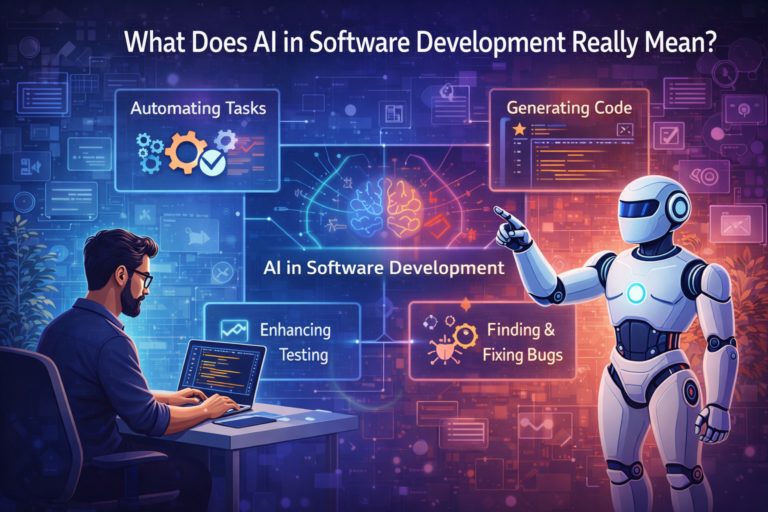
What Does AI in Software Development Really Mean?
When individuals are reading about AI in software development they tend to think of machines creating entire programs by themselves. This is not what is being experienced in real life.
Today, AI is mainly used to:
- Help write code
- Suggest improvements
- Catch errors earlier
- Automate the monotonous development tasks.
This is referred to as AI-assisted code, rather than autonomous software engineering.
In Simple Words, AI acts as a smart assistant. It helps the developers- it does not displace them.
Can AI Completely Replace Developers?
This is one of the most common questions people ask:
“Can AI replace developers?”
The truth of the matter is no–not quite.
Developing software is a lot more than writing code. It requires:
- Understanding unclear or changing requirements
- Making smart design choices
- Trade-off between performance, cost and scalability.
- People who are non-technical to communicate with.
AI doesn’t understand the business context and human intent as human beings do. It functions on pattern , and not true understanding.
So while AI is changing how development works, it isn’t eliminating the need for developers.
What AI Does Well in Coding?
AI performs best in already defined patterns.
Its strengths include:
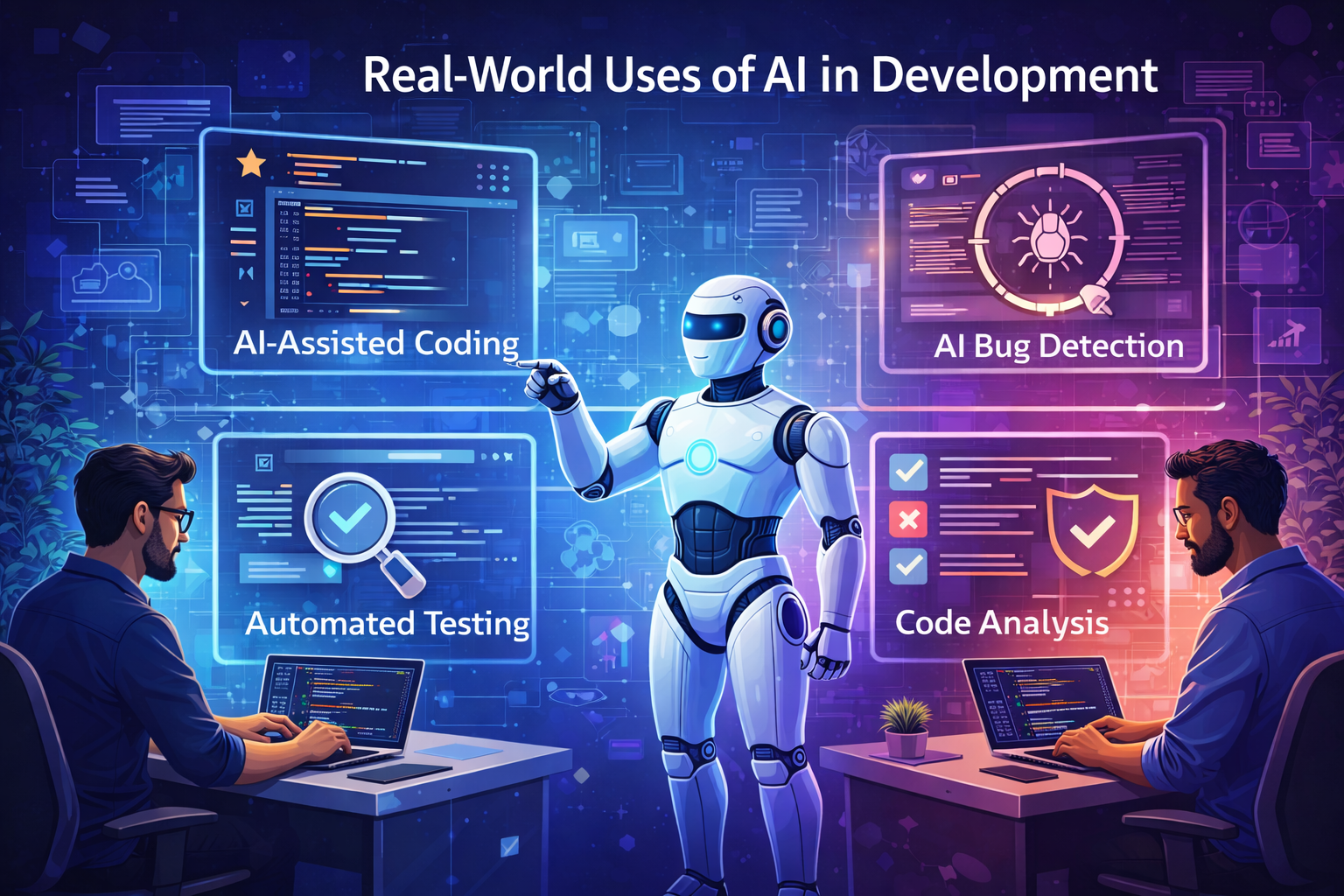
- Auto-completing code
- Fixing syntax errors
- Generating basic functions
- Refactoring of duplicate code.
- Helping in documentation.
- Assisting in testing and debugging.
These assist in saving time and reduces manual efforts- but still, they require human guidance and inspecting.
What Human Developers Do Better ?
This is where the difference between human intelligence and artificial intelligence becomes clear.
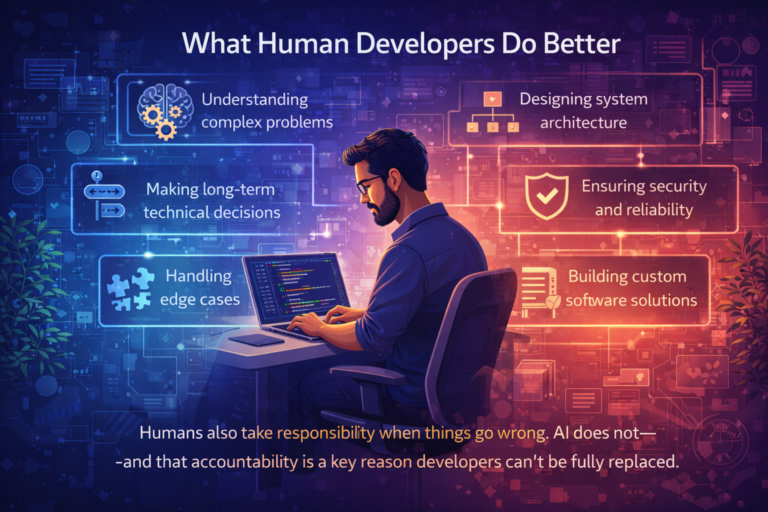
Human developers excel at:
- Understanding complex problems
- Designing system architecture
- Making long-term technical decisions
- Handling edge cases
- Ensuring security and reliability
- Building custom software solutions
Humans also take responsibility when things go wrong. AI does not—and that accountability is a key reason developers can’t be fully replaced.
AI vs Human Developers: A Practical Comparison
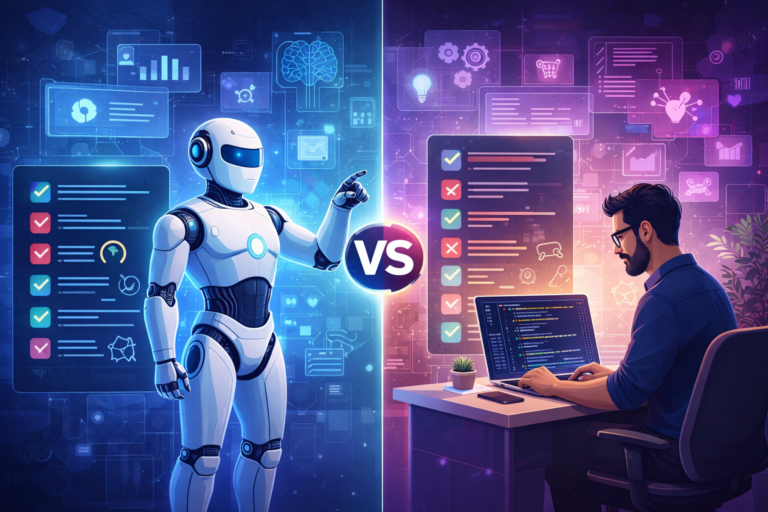
This comparison shows that AI and humans play very different roles.
Area | AI | Human Developers |
Speed | Very fast | Moderate |
Creativity | Limited | Strong |
Context understanding | Weak | Strong |
Business logic | Pattern-based | Experience-based |
Accountability | None | Full ownership |
Adaptability | Low | High |
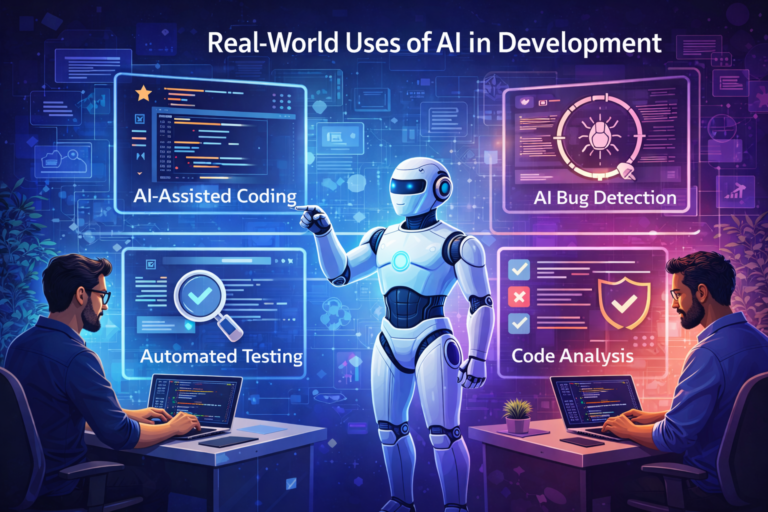
Real-World Uses of AI in Development
Nowadays, AI is already involved in numerous real-life initiatives.
Common examples include:
- Code suggestion tools
- Automated testing systems
- Bug detection tools
- Performance analysis tools
They enhance the productivity, and they do not eliminate the need for human decision-making. As a matter of fact, AI is appropriate when developers retain authority.
How AI Is Affecting Programming Jobs?
A major concern is:
“Will developers lose their jobs to AI?”
The reality is more about change than loss
What’s actually happening:
- Repetitive tasks are being automated
- Demand for skilled developers remains strong
- New roles are emerging around AI-powered development
Developers who adapt and continue learning remain highly valuable. The impact of AI on software jobs is about evolution, not replacement.
The Human + AI Collaboration Model
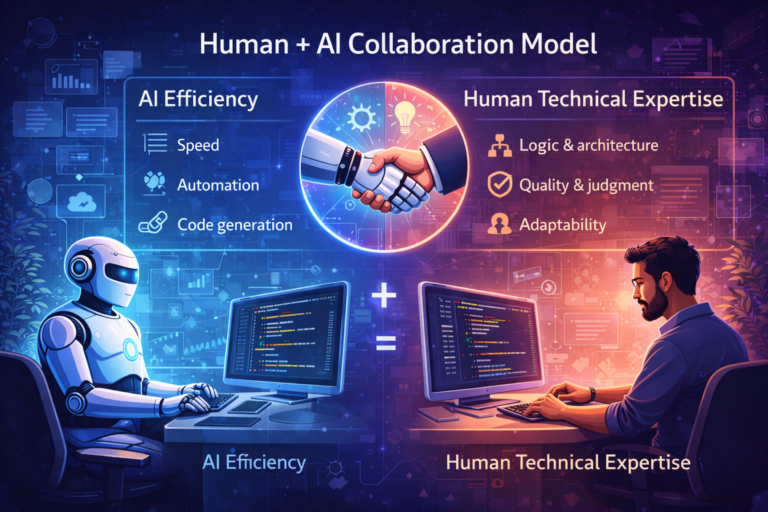
The most realistic future is one where humans and AI work together.
Developers can use AI to:
- Increase speed and efficiency
- Focus on logic, architecture, and quality
- Review and refine AI-generated code
- Apply judgment where automation falls short
This combination of AI efficiency and human expertise consistently produces better results than either could alone
The Future of Software Developers
The future isn’t about competing with AI—it’s about using it wisely.
Developers will continue to succeed by:
- Solving real-world problems
- Designing scalable applications
- Understanding users and business needs
- Treating AI as a tool, not a threat
Coding remains a strong career choice, especially for developers who keep learning, understand AI tools, and think beyond just writing code.

FAQs (Frequently Asked Questions)
Q1: Will AI replace software developers?
Ans: No. AI supports developers but can’t replace human reasoning and responsibility.
Q2: Can ChatGPT replace programmers?
Ans: It can help with coding tasks, but it can’t independently build or manage full software systems.
Q3: Is coding still a good career?
Ans: Yes. Developers who adapt to AI tools remain in high demand.
Q4: Will developers lose jobs to AI?
Ans: Some repetitive roles may decline, but skilled developers are still essential.
Q5: Can AI build complete software?
Ans: AI can generate parts of software, but humans must design, validate, and maintain it.
Q6: Is AI better than human developers?
Ans: AI is faster at certain tasks, while humans excel at complex decision-making.
Final Perspective
AI vs human development is not a battle.
AI is transforming how software is built, but it doesn’t replace the human thinking behind it. The best outcomes happen when people and technology work together.
At CodeX Geeks, we combine human expertise with AI tools to build scalable, intelligent digital solutions—focused on solving real problems, not chasing trends.
The future of development belongs to humans who know how to work with AI, not fear it.